I like the way the threshold of the new year falls midway on the arc between Christmas and Epiphany. With the bustle of Christmas preparations accomplished, there’s a set-apart nature to these days before the world takes up its usual pace again.
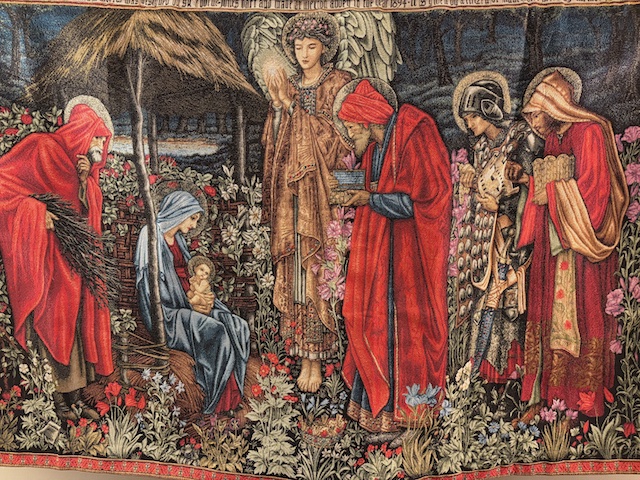
There’s a tapestry that echoes this sense of transition and bridges this turning of the year. It’s an image of divinity born into the world, which is honored by those with the wisdom to see. It reminds me that the divine indwelling we’ve just celebrated at Christmas is what carries us forward into the unfolding of the new year.
Adoration of the Magi is a William Morris tapestry that took years to complete. It depicts the light that leads us to the heart of our lives, and the hush of the encounter we find there. The model for the tapestry was painted by British artist Edward Burne-Jones. A friend pointed out that he was part of the pre-Raphaelite Brotherhood, a movement of artists reaching back toward a medieval aesthetic they experienced as closer to the Source.
The tapestry took almost four years to weave. It was commissioned by the Rector of Exeter College in Oxford, England, who did not live to see its completion. The piece was to hang among stained glass windows, and thus incorporated vibrant color in order to hold its own in that setting. It was completed and installed in 1890.
In the center, an angel uses two hands to hold aloft a source of light. On one side, Mary is seated holding the baby with Joseph standing behind. On the other side, the magi approach the holy family with their gifts.
The light high in the center is what sent me searching out the source of an image I encountered briefly last year. The skillful and beautiful rendition of light held me riveted. Christmas is all about light, and I was glad to find a reproduction of the tapestry to display for the holidays.
This piece of art, like most everything we create, blooms from a long series of artistic expressions offered over millennia. The color and scale of the masterfully woven original tapestry was informed by the work of architects and stained-glass artists. The light conveyed on the tapestry is a study of the painting by Edward Burne-Jones rendered into tactile form. His original work on canvas is elevated by a long history of artistic explorations of light and form, and it visually conveys the story that unfolds in the written words of scripture. That story in turn is translated from the ancient language of a time and place far away, by writers who make it accessible to their own culture. In every iteration, artists keep meaning and beauty alive in a new form, shining its light into their own time.
There’s more to learn about this tapestry, particularly about the symbolism of the various plants in the background. Each would have had its own associations and metaphorical meaning. The work is perceived by the mind along with the heart, with a presence that resonates in the body as well.
When we connect with art it kindles new experiences and new realities. Creation happens anew. We carry the light into an ever-new context, even as the light leads our way.
Susan Christerson Brown